
Director Yohei Kameyama‘s concept boards and 3D animatic set the course for Mori Calliope‘s fully 3D animated music video, “LET’S JUST CRASH”. Toei Zukun Laboratory and Kanaban Graphics developed the characters, race action and vehicle mechanisms through a steady exchange of ideas. We look at how the team brought the race to life while capturing Calliope’s personality in its performances and details.
This article originally appeared in CGWORLD + digital video, vol. 336 (August 2026 issue)
A Ridiculously Fun Race
How did the project begin?
Takahiro NomuraCalliope’s team approached Toei Zukun Laboratory (ZUKUN) about a new music video. The song had already been chosen as the opening theme for the second cour of the TV anime Gachiakuta, so they wanted to give it special attention. There wasn’t a director attached yet. We were asked to suggest candidates, and Kameyama was our choice. Calliope already knew his work and was enthusiastic about the idea, so we approached him.
Yohei KameyamaWhen I first heard about it, Calliope’s team already had the beginnings of an idea: a car race that would be ridiculously fun. The main character, Challenger, already existed, but King and Queen hadn’t been created yet.

That developed into a story centered on the three characters we see now: Challenger, King and Queen.
KameyamaInitially, they were imagining a chaotic race with lots of characters, something like Wacky Races or Mad Max. Building all those different characters in 3D would have driven up production costs, so I proposed focusing the race on Challenger and King. My first job was to turn the original concept into something we could realistically produce.
When did Queen enter the picture?
KameyamaCalliope’s rapping and singing on “LET’S JUST CRASH” were so compelling that I felt we needed a character to perform those vocals on screen. A singing performance would also suit the video’s visual style. I initially proposed a character who embodied Calliope herself, but she didn’t want to put herself too prominently in the foreground. Queen became a separate character who would perform the song. At first, we deliberately made her blonde to distinguish her from Calliope.
NomuraAfter we submitted the animatic, we exchanged ideas with Kameyama and Calliope’s team. We began to feel that fans would appreciate a stronger sense of Calliope’s personality. Queen’s hair eventually became pink, and we adjusted her design to bring out more of that connection. She remains a separate character, but you can still recognize this as a Calliope music video.
Her previous two videos, “Seeing Stars feat. Lotus Juice” and “Die For You,” also convey Calliope’s presence through KAMIYA’s live-action appearances.
NomuraAcross those videos, I get the impression that Calliope has been exploring ways to express herself without always appearing front and center. This time, the challenge was to do that through 3D animated characters.
What material did you share with Kanaban Graphics (Kanaban)?
Natsumi NukariyaI was Kanaban’s line producer. When Nomura and Kameyama first came to see us, the animatic wasn’t finished, but Kameyama had prepared a proposal of around 15 pages. It included design ideas and background information for the three main characters and their cars, a rough story outline and concept boards. The world was already well developed. My immediate reaction was, “This is so cute. We have to do this.”
Yuta ImakiI served as Kanaban’s CG director and rigging director. We handled the main character and vehicle assets, along with most of the shot production. ZUKUN created some props and environments, recorded Calliope’s motion capture and animated the Dead Beats, the skeleton characters. We weren’t working from detailed turnarounds or model sheets. We took the design proposals, supporting references and intended staging, then worked out how to make them function in 3D.
NukariyaKameyama’s Milky☆Subway: The Galactic Limited Express began streaming while we were in production. The team watched it and drew on his style when refining the assets and staging the shots.
Even the early concept boards show the final gag, with the trophy hitting Queen on the head. Did you know how the video would end from the outset?
KameyamaThat gag was clear from the beginning. I often develop ideas for music videos while listening to the track, and the images came particularly easily this time. The trophy gives her a little bonk on the final note. If we got that timing right, I thought it would be a funny image, so I wanted to build toward it.
NukariyaI hadn’t even heard the song at that stage, but I remember how enthusiastically Kameyama talked about making the last shot land precisely with the music. The proposal alone conveyed the satisfying finish he was after.
Designing the Three Leads
Kameyama’s initial designs for Challenger, King and Queen established their roles and personalities as well as their costumes and silhouettes. The video’s direction was already taking shape. Queen was originally blonde, emphasizing her separation from Calliope.

Concept Boards for the Race and Its Final Gag
Kameyama created 10 concept boards. They already established the video’s energy and humor, from A, Challenger steering skillfully past Queen’s dangerous traps, to B, the trophy tapping Queen on the head in the final shot.


An Earlier Version of the Ending


Four Months to the Finish Line
There is a lot packed into this fully 3D animated video. How long did production take?
NukariyaThe actual production period was around four months. That’s tight for a 3D project of this scale, so character, vehicle and environment modeling overlapped with rigging, animation and shot production.
ImakiWe also had a wide range of requirements: singing performances, high-speed racing, vehicle destruction, fire and smoke. To deliver all that in the time available, we had to decide early where to concentrate our effort.
With so little time, choosing what to leave out was as important as choosing what to build.
KameyamaYes. I wanted to focus our effort on what mattered most to the video. For example, an early idea was to put a moat-like chasm around the foot of the tower, with lava flowing through it. That would have heightened the danger, but fluid simulations are computationally expensive. I decided the scene would work without it, so we dropped it.
ImakiThose decisions really helped. King’s face is masked until near the end, so we could limit his range of facial expressions. Queen’s singing, on the other hand, received a lot of attention in the lip sync and facial animation. We had a clear sense of where to invest the work.
KameyamaCalliope’s rapping and singing are a huge part of the song’s appeal. From the outset, I knew Queen’s lip sync had to feel right. I planned the rest with the workload of 3D production in mind.
NukariyaThe ending changed from the concept boards, too.
KameyamaOriginally, Challenger was going to get out of his car and carry King on his back to the finish. Animating someone running with another person on their back is difficult. Keeping them in the car would preserve the speed and feel better on screen, so I changed it.
Did you also adapt the designs for 3D production?
KameyamaCalliope’s sketch for Challenger included large spikes on the front of his shoulders. In 3D animation, those would intersect with other geometry and cause problems, so I simplified that area early on.
NomuraWe gave a lot of thought to where our effort would have the greatest effect, rather than trying to include every idea.
KameyamaI wasn’t trying to minimize the work everywhere. I was asking where an extra push would make the biggest difference. That was on my mind from the very beginning.
Blocking Out the Race in 3D
Your animatic establishes the cars’ relative positions, camera moves and editing rhythm in considerable detail.
KameyamaFor a race, I wanted to work out the spatial relationships first: where Challenger takes the lead, where Queen interferes and when the camera moves. If those things are vague, the video loses its impact. I began blocking it out in Blender early on, moving the cars around as I worked.
The cars and characters are very simple, yet your staging comes across clearly.
KameyamaThe cars are little more than boxes, and the characters are drawings on polygon planes, but you can still understand what’s happening. I particularly wanted everyone to grasp the video’s energy from the start.
NukariyaI was pleasantly surprised to receive a 3D animatic rather than a 2D one. It communicated the whole race and made the intent clear: where Kameyama wanted to emphasize speed and where the action should hit the music.
ImakiRace action depends on understanding where the cars are in relation to each other. Having that established in the animatic was a huge help. The shot team could picture the finished sequence much more easily.
In many scenes, the camera moves and cutting are almost unchanged from the animatic.
KameyamaThey stayed very close this time. We made small adjustments during production, of course, but the underlying rhythm and attitude remained the same.
You also captured Calliope’s own performance. How did you use that data?
NomuraWe never planned to use the motion capture unchanged. It was reference material for finding the qualities that make a performance feel like her. We recorded it during the same session as the capture for her later video, “Gold Unbalance feat. Kento Nakajima.”
KameyamaThe way she moves when she raps is very personal: how she shifts her weight and swings her arms, for example. I wanted to study that properly, so I asked for the capture.
NukariyaLooking through the data revealed a lot of nuances. The animators discussed which details they wanted to preserve as they refined the performance.
Queen’s thumbs-down gesture at the start of the race also came from Calliope’s performance, didn’t it?
NukariyaIt was already in the capture data. It’s a strong gesture, though, and holding it on screen too long would give it too much emphasis. We show it briefly, then immediately dolly out.
KameyamaI felt that slightly rebellious edge was part of Calliope’s personality. We kept it and found a way to make it work in the scene.
NomuraQueen is a separate character, but this still has to work as a Calliope music video. We were very conscious of that balance.
How did you keep everyone in close communication?
NukariyaWe tracked the overall schedule in Asana and used Slack for day-to-day communication. We also held meetings roughly every two weeks, with Kameyama, Nomura and Kanaban’s core team reviewing each department’s progress and outstanding issues.
What did those meetings cover?
NukariyaWe discussed creative intent and priorities as well as progress: what direction a shot should take and where to concentrate our effort. With such a tight schedule, we needed prompt decisions on whether to keep moving or go back and revise something.
ImakiFeedback came quickly. When we submitted shots for review, we received specific directions such as “Push the camera in further here” or “This is approved.” We could move forward without second-guessing the direction.
NomuraWe made a point of deciding on a direction promptly. Details needed consideration, but we couldn’t let the whole production lose momentum.
KameyamaI tried not to leave people waiting for an answer. The animatic had already established the direction, so everyone understood what each shot needed to communicate. I think that helped enormously.
From 3D Animatic to Final Frames


Easter Eggs With Calliope’s Signature
The video rewards repeat viewing. It’s full of motifs and references associated with Calliope.
KameyamaWe scattered small details throughout the frame to identify it as her music video. I wanted her presence to come through in the cultural references and visual symbols, without putting her directly on screen in a prominent role.
NukariyaThe speakers on Queen’s truck are a good example. Their design and arrangement come from the “NEZUMI Scheme” video. We brought that design into 3D, including the skull in the middle.
NomuraIt’s a reference for fans who recognize it.
ImakiHonestly, we wondered whether anyone would notice.
KameyamaThat felt about right. I didn’t want to draw too much attention to it.
The detonator case and the graffiti on the truck also stand out.
NomuraZUKUN created most of the graffiti. Much of it was drawn specifically for this project, rather than reused from earlier videos. The detonator case was designed as though Queen had decorated it herself. Kameyama provided the “DANGER” lettering in his design sheet. Our designer then imagined what Queen would draw, adding Calliope-related motifs such as the Grim Reaper.
NukariyaQueen’s “gyaru mic” was memorable, too. We used Calliope’s existing microphone model and decorated it to evoke Japanese gyaru fashion as strongly as possible.
Calliope References in the Props


Even the Dead Beats’ colors are a reference.
NukariyaThey’re based on the colors of Calliope’s YouTube membership loyalty badges, which change according to how long someone has been a member. We used beige, pale pink and deep pink to suggest different membership durations: newcomers, a few months and a few years. That idea came from one of Kanaban’s modelers.
There are a lot of details for fans to discover.
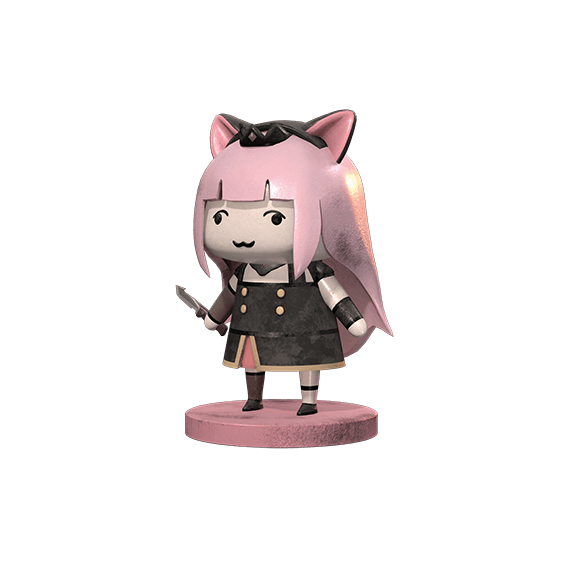
NomuraWeird Cat is another example. Calliope’s team asked us to include it. COVER Corporation supplied an existing model, which Kanaban adapted for this video.
ImakiIt takes the place of one of those hula dancer dolls you see on dashboards in old American films. We even rigged it to sway like a doll.
NukariyaYou only get a clear view of its face for a few frames, in the shot where Challenger turns back partway up the tower.
ImakiAt first, I thought we’d barely shown it at all. Then I spotted that moment and burst out laughing.
KameyamaThat’s just enough. Leaving it on screen the whole time would feel forced. I wanted people to enjoy the video on a first viewing and discover the details later.
Weird Cat on the Dashboard

Fine-Tuning the Race to the Music
The overall direction was clear early on. How much did suggestions from the production team change the result?
KameyamaQuite a lot. The animatic established the story and staging, but the team kept finding ways to make the images more satisfying during production.
NukariyaThe scene where Queen’s truck fires spears at Challenger and King already worked in its early form. It’s also a big moment in the song, so I asked the shot team to try stronger sunlight and flares to give it more rhythmic impact. They quietly worked them in.
KameyamaThat suggestion really changed the feel of the scene.
NukariyaThere is a lot of dust and explosive action in the video. Strong backlighting and sun flares gave it more atmosphere and visual impact.
KameyamaWe also revised the shot where Challenger turns back on the tower, following a suggestion from Kanaban.

In the animatic, the trophy at the top of the tower is out of frame.
ImakiWe thought it would be more dramatic if viewers immediately understood how close he was to the finish. We suggested including the trophy in the composition.
KameyamaIt was a great idea. One image now tells you that he’s come all this way and is choosing to turn back.
Working in 3D also lets you depict distances and spatial relationships accurately.
KameyamaThat actually made things difficult at times. Distances can feel too literal in 3D. Near the end, Challenger keeps driving toward the finish. The original edit held the wide view of the background for a little longer, which made you wonder why the finish was still so far away when he was supposed to be nearly there.
NukariyaWe moved the camera close enough to Challenger that you could barely see the background. Reducing that spatial information helped us maintain the momentum to the end.
KameyamaI wanted the rush of racing to the finish to take priority over literal distances. It also made the world feel less like a miniature set. In a music video, the images and the track have to feel good together.
NukariyaWe tested the timing in detail. Shifting a camera push-in by just a few frames can change the rhythm considerably.
KameyamaOne of the hardest decisions was where the camera moves should hit the music. Pushing in on the beat feels straightforward and satisfying. In some shots, though, delaying the move toward the offbeat creates a little anticipation and gives it more momentum.
NomuraBoth versions worked, which made it harder to decide.
KameyamaI wanted a fresh perspective, so Kanaban ran an internal survey for us.
NukariyaWe showed both versions to staff who weren’t on the project and asked which felt better. After working on something for so long, you lose perspective. We wanted to understand how it felt to a first-time viewer.
ImakiThe speed of the race is tied directly to the song’s groove. We cared more about which version made you move with the music than which was theoretically correct.
NomuraAnd that difference is hard to put into words. [Laughs]
NukariyaEven the animators and the four of us had different opinions. Everyone had a reason for their preference, which was interesting.
Those sound like very intuitive adjustments.
KameyamaThat’s crucial in a music video. A sequence can work in theory and still fail to make you feel the groove. We began with the idea of making something ridiculously fun, so I kept thinking about tempo and momentum right to the end.
Kameyama’s concept boards and animatic gave you a starting point, but everyone kept looking for ways to improve the video.
KameyamaThe team kept coming back with ideas. They added a great deal of energy to the piece.
NomuraIt was a short schedule, but everyone approached it positively. I think the finished video has the momentum that “LET’S JUST CRASH” deserves.
The Kanaban Team


Technical Breakdown
Bringing Kameyama’s Character Style Into 3D
The three leads combine the cuteness and allure characteristic of Kameyama’s work with forms that feel convincing in 3D.


Reproducing the distinctive look of Kameyama’s Blender work in a Maya-based pipeline was a major part of look development. The team chose Redshift to give the characters a lifelike yet slightly figurine-like appearance within the schedule. Particular attention went into the hairlines and grouping of hair strands to capture his style.
Keeping Queen’s Scars in Place
Queen’s distinctive mouth-corner scars would stretch or distort during lip sync and facial animation if applied as conventional surface textures. The team instead built a rig to control projected scar textures, using three separate texture elements on each side of the mouth.


Facial Rigs Built for Each Performance
With so much singing to animate, it was difficult to predict all the expression targets Queen would need. A joint-based facial rig provided the flexibility to shape her performance.
The body rigs used mGear, while the facial rigs were custom-built for flexibility. Blend shapes were reserved for forms that were difficult to achieve with joints alone, including a blink, and the expression created specifically for the trophy impact in the final shot.


Challenger needed a smaller range of expressions, so his facial setup combines a limited set of morph targets.


Targets for blinking, glaring, a troubled expression, and alarm. Separate targets also control individual areas such as the eyes and mouth. Matching Challenger’s facial topology to Queen’s allowed her joint-based facial rig to be reused for further adjustments, giving animators scope to refine each shot. As with Queen, the brows are controlled entirely by joints, without blend shapes
Vehicles Built for the Wasteland
Kameyama, ZUKUN and Kanaban gathered references and refined the vehicle designs and mechanical details together.


Challenger’s and King’s cars are based on the air-cooled Beetle, with the character of desert rally cars. Kanaban developed their structures and details from Kameyama’s sketches. ZUKUN’s graffiti artwork was repositioned and recolored to suit the bodywork. Believable materials ground the stylized shapes, while the cars’ condition reflects their owners’ personalities and ways of life.


Giving Queen’s Performance Its Impact
The layout established a gradual build in Queen’s singing performance, culminating in a strong pose timed to a key lyric


B
Redshift renders were delivered as EXR files ontaining AOVs, then composited in After Effects (AE). The pass labels below follow the production breakdown.


Color
A CryptoObject pass provided masks for individual parts. Separating the elements gave the team flexibility to refine materials and lighting in AE. Deadline and an in-house compositing automation tool streamlined rendering and the preparation of initial AE composites. This helped establish a consistent look across the shots quickly, leaving more time for refinement.

Starting the Race With EmberGen
Fire, smoke and fireworks erupt from Queen’s truck as she signals the start. EmberGen was used for some of the fire, smoke and dust effects, matching the video’s look based on physically based rendering (PBR). Real-time previews let the team adjust the force of the flames and the spread of smoke as they worked. The layout animation provided a basis for timing the bursts and dust trails to the truck’s movement. Compositing refined the glow and the density of effects across the frame to heighten the excitement.


Keyframing the Tower’s Collapse
The enormous tower in the final race sequence was built as an asset that could be animated to collapse.


Bringing the Trophy Into Frame


Landing the Final Gag
Selected earlier versions of the final shot, in which the trophy hits Queen on the head. Enlarged views show the changes to her expression.


A


D


G


